
Building Resilience in Children Through Therapeutic Play

How Resilience Takes Root: The Science of Helping Children Adapt Through Adversity
In the face of adversity, people often move forward with remarkable strength, perseverance, and resilience. In developmental science, resilience is defined as the capacity of a dynamic system to adapt successfully to disturbances that threaten its functioning, survival, or development (Masten, Lucke, Nelson, & Stallworthy, 2021). It is not understood as a fixed personality trait or a heroic refusal to struggle. Rather, resilience is a dynamic process that emerges through interactions among biological, developmental, relational, and broader social-cultural systems (Masten et al., 2021; Ungar, 2011). In other words, resilience is not simply something within a person; it is also something supported—or constrained—by the world around them. This raises an important question. When children and young people face serious adversity, what helps some adapt and recover while others continue to struggle? To answer it, we will trace the history of resilience research, examine the systems and relationships that support positive adaptation, and consider science-based strategies for helping resilience take root.
A Brief Overview of Resilience: From “Bouncing Back” to Multisystem Adaptation
Etymologically, the word resilience comes from the Latin resilire, meaning “to leap back,” “recoil,” or “spring back.” The term entered the English language in the 1620s, initially referring to the act of rebounding after pressure or force. It later became common in physics and engineering, where it described a material’s capacity to absorb stress and return to its original shape. This earlier meaning continues to influence how resilience is discussed today, particularly when people are described as having “bounced back” after hardship. The limitation of this metaphor, however, is that people are not made of rubber. Following trauma, chronic stress, loss, or developmental adversity, individuals may recover, reorganize, adapt, or grow, but they do not necessarily return unchanged to who they were before.
Historically, within developmental science, Norman Garmezy is often regarded as a founder of modern resilience research. During the 1970s, his studies of children at elevated risk for psychopathology helped shift attention away from vulnerability alone and toward competence, adaptation, and protective processes. This research tradition was later advanced by Ann Masten and colleagues, who demonstrated that resilience often depends on ordinary developmental resources—famously described as “ordinary magic”—including supportive caregiving relationships, self-regulation, cognitive abilities, and engagement with school (Masten, 2001). Emmy Werner and Ruth Smith’s influential Kauai Longitudinal Study similarly followed children across development and found that approximately 36% of those exposed to multiple risk factors nevertheless became competent, caring, and well-functioning adults (Werner & Smith, 1982; other studies suggest that some 20 to 40% of young people can demonstrate resilience in the face of adversity).
During this same broad period, Michael Rutter advanced the field by emphasizing protective mechanisms rather than focusing only on protective factors. This distinction drew attention to how particular resources alter developmental pathways and reduce the effects of adversity over time. Dante Cicchetti further situated resilience within a multilevel developmental psychopathology framework, arguing that it should be examined across interacting biological, neurobiological, psychological, relational, and environmental levels of development.
Later, building on these foundations, Michael Ungar and his collaborators conducted the International Resilience Project, identifying 32 domains of resilience organized across four broad dimensions: individual, relational, community, and cultural resources (Ungar, 2008; Ungar & Liebenberg, 2009, 2011). Similarly, Llistosella et al. (2021) proposed the Individual and Environmental Resilience Model, an evidence-informed framework that conceptualizes resilience as a dynamic process that emerges from interactions between individual and environmental systems. Within the model, each system contains multiple interconnected domains that may support adaptive functioning under conditions of stress or adversity.
Taken together, these research traditions highlight several central principles. First, positive adaptation following adversity is relatively common, although estimates vary considerably depending on how adversity, functioning, and resilience are defined. Across some studies, approximately 20% to 40% of children and adolescents exposed to significant adversity have been classified as demonstrating resilient outcomes. Second, resilience does not arise solely from individual characteristics such as intelligence, temperament, or self-regulation. It is also supported by environmental resources, including stable relationships, responsive caregivers, safe schools, community supports, and access to meaningful opportunities. Third, resilience involves more than a collection of protective factors. It also involves the mechanisms through which these resources interact over time to alter developmental pathways and support positive adaptation.
Science-Based Factors that Commonly Contribute to Resilience
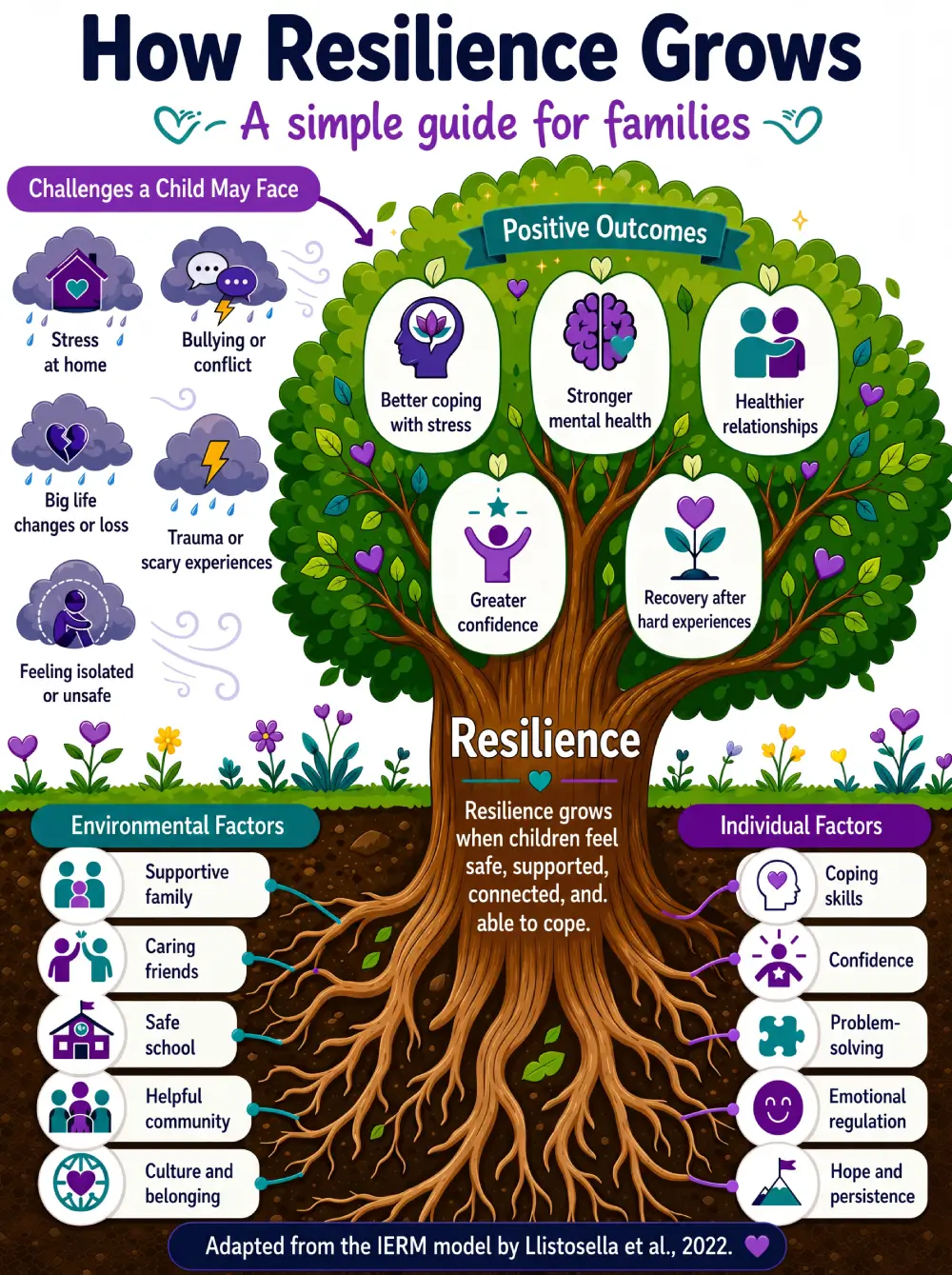
Models such as the Individual and Environmental Resilience Model (IERM) provide a broad framework for understanding the multidimensional and dynamic nature of resilience. As illustrated, the individual dimension includes biological, behavioural, communication-related, cognitive, and emotional factors that collectively reflect a person’s capacities for adaptive functioning. The environmental dimension includes family, school, peer, cultural, and community factors, highlighting the external relationships, resources, and contexts that can support resilience.
Within the individual dimension, biological factors include differences in stress responsivity and neurobiological regulation, such as those associated with age, sex, genetics, epigenetics, neuroplasticity, hormonal functioning, and neurological development. Behavioural capacities, including adaptive coping, perseverance, and physical activity, all of which may further support stress management and adjustment. Communication skills, such as social and interpersonal competence, can help individuals express their needs, navigate relationships, and access support. Cognitive capacities, including problem-solving and flexible thinking, influence how individuals interpret and respond to challenging experiences. Emotional capacities, particularly self-regulation, optimism, self-esteem, and a sense of being supported, are also frequently identified as important contributors to positive adaptation.
Within the environmental dimension, family factors such as responsive parenting, emotional warmth, structure, and support can provide an important foundation for security and regulation. School factors, including engagement, safety, connectedness, and access to supportive adults, may promote competence and stability beyond the home. Peer support and positive social connections can strengthen belonging and social adjustment, particularly during adolescence. Culturally affirming practices, shared traditions, and community involvement may also foster identity, meaning, and purpose while helping to buffer the effects of stress, exclusion, and marginalization (Ungar, 2019).
Taken together, broad frameworks such as the IERM offer a science-informed way of examining the many domains of resilience. These models can help young people and the adults around them identify existing strengths, unmet needs, and areas where additional support may be beneficial. In turn, this information can guide the development of meaningful strategies and environments that promote well-being, adaptation, and positive developmental outcomes.
Concluding Remarks and Ideas to Foster Resilience
Resilience refers to the capacity of a dynamic system to adapt successfully when faced with disturbances that threaten its functioning, survival, or development. It is a common and evolving process that can be strengthened through a range of individual capacities, supportive relationships, and environmental resources. Family members, caregivers, clinicians, teachers, and communities all play an important role in helping children develop the internal skills and external supports needed to navigate difficult experiences. In everyday life, fostering resilience means helping young people feel connected, capable, supported, and hopeful, particularly during times of stress or adversity. With this goal in mind, the following science-informed strategies are organized for two audiences: first, adults, caregivers, and teachers; and second, children and youth.
Ideas for Adults when Considering Environmental Factors
- Maintain Supportive Family Connections: Supportive family relationships help children and youth cope with adversity, including stress related to poverty, illness, family conflict, or violence (Wang et al., 2024). This does not have to be complicated. Small, consistent moments matter: checking in after school, eating meals together, reading before bed, going for walks, or having one-on-one conversations without distractions.
- Connect Home and School Supports: Schools can strengthen resilience by using evidence-based programs, especially those rooted in Cognitive Behavioural Therapy, to teach coping skills, emotional awareness, and problem-solving (Pinto et al., 2021). Caregivers can support this by staying connected with the school and asking questions such as, “Who is my child’s trusted adult at school?” or “What support is available when my child feels overwhelmed?” When adults use the same language at home and school, children are more likely to apply the skills. For example, if a child is learning about “big feelings” or “unhelpful thoughts” at school, caregivers can use those same words during homework struggles, friendship conflicts, or morning routines.
- Build Community Support: Children benefit from safe, nurturing community spaces where they can develop positive relationships with adults and peers (Wang et al., 2024). This might include sports, arts programs, clubs, mentoring programs, faith or cultural groups, or other youth activities. The goal is not to overschedule young people, but to help them find one or two spaces where they feel known, valued, and included.
- Address Bullying Directly: Resilience-building strategies could be paired with strong anti-bullying efforts. A sense of meaning, supportive relationships, and psychological coping resources can help buffer the impact of bullying, but children should not be expected to “be resilient” in unsafe environments (Seon & Smith-Adcock, 2023). Adults need to model healthy relationships, identify safe peers and trusted adults, take bullying seriously, and intervene when needed.
- Check What Is Working, Over Time: Resilience supports should be regularly reviewed to make sure they are actually helping and are appropriate for the child’s developmental, cultural, social, and individual needs. Adults can ask simple questions such as, “What helped this week?” “What felt hardest?” or “What should we try differently next time?” With adolescents, this works best when it feels collaborative rather than controlling: “Let’s plan out the week together,” or “What was most difficult this week, and how can I support you?”. And keep in mind, that resilience unfolds over time, so consistently implemented interventions can potentially shift a developmental trajectory.
Ideas for Adults When Considering Individual Factors
- Teach Emotional Regulation Skills: Resilience is sometimes strengthened when children learn how to manage rumination, distracting thoughts, and feelings of helplessness (Rudolph et al., 2024). Adults can help by teaching children to name their emotions, notice where those emotions show up in the body, and choose coping strategies that fit the situation. This might include breathing, movement, problem-solving, taking a break, talking to a trusted adult, or using a calming routine.
- Help Develop Emotional Literacy: Children need help identifying, understanding, and expressing emotions in healthy ways. For younger children, this may involve feelings charts, books, drawings, play, or simple labels such as mad, sad, scared, happy, excited, or worried. Adolescents may benefit from more specific language, such as overwhelmed, rejected, uncertain, embarrassed, elated, disconnected, or confident. The more accurately young people can name what they feel, the easier coping and adapting effectively becomes.
- Use Strengths-Based Supports: Children and teens become more resilient when adults notice and build on their existing strengths, such as curiosity, creativity, humour, kindness, persistence, problem-solving, or leadership. Instead of only saying “good job,” adults can focus on effort and be more specific: “You kept trying even when that was frustrating,” or “You were really thoughtful in how you handled that.” Strengths can also become coping tools. A creative child might draw a plan, a social child might study with a friend, and an active child might regulate through movement.
- Support Development of Meaning and Purpose: Adolescents are more resilient when they have opportunities to reflect on what matters to them, set realistic goals, and take steps toward those goals (Seon & Smith-Adcock, 2023). Meaning can come from friendships, family, culture, music, sports, learning, helping others, spirituality, creativity, or personal goals. Adults can support this by asking questions such as, “What matters to you?” “What helps you feel proud of yourself?” or “What kind of person are you trying to become?”
- Teach That Emotions Can Change: Children and teens benefit from learning that emotions are real, powerful, and manageable. Short lessons that teach a “growth mindset” about emotions can improve emotional resilience (Rudolph et al., 2024). Adults can model this by saying things like, “This feeling is really intense right now, but it will not stay this strong forever,” or “You were at a 9 out of 10 earlier, and now you’re at a 5. What helped bring it down?”
Ideas for Young People When Considering Individual and Environmental Factors
- Spend Time With People Who Care About You: Being resilient does not mean handling everything alone. It means knowing who your safe and trusted people are. This could be a parent, caregiver, teacher, coach, grandparent, sibling, friend, counsellor, or another trusted adult. Small moments can help a lot, like talking after school, eating together, going for a walk, reading together, or having a quiet conversation without phones or distractions.
- Know Your Go-To Adults at School: School can be stressful sometimes. It helps to know who you can go to when things feel too big. This might be a teacher, guidance counsellor, principal, support worker, coach, or another trusted adult. It can also help when home and school use the same words for coping skills. For example, if you learn about “big feelings,” “unhelpful thoughts,” or “calming strategies” at school, you can use those same ideas at home too.
- Find Places Where You Feel You Belong: Having a community can help you feel stronger. This could be a team, club, art class, music group, gaming group, youth program, cultural group, or any place where you feel accepted. You do not need to do a million activities. One or two good places where you feel known and valued can make a big difference. If trying something new feels scary, you can start small, visit first, bring someone with you, or meet the leader before joining.
- Remember That Feelings Change: Big feelings can feel like they are going to last forever, but they usually do not. A feeling can be huge at first and then slowly shrink. You might say to yourself, “This feels really intense right now, but it will not stay this strong forever.” You can also rate your feeling from 1 to 10 and notice what helps it go down. Maybe it was breathing, music, moving your body, talking to someone, drawing, resting, or getting space.
- Learn Ways to Calm Your Body and Brain: Everyone gets stuck in big feelings sometimes. You might overthink, worry, replay things in your head, or feel like nothing will get better. Coping skills can help. Try naming the feeling, noticing where it shows up in your body, and choosing one helpful action. You might take slow breaths, stretch, go for a walk, drink water, take a break, write things down, talk to someone, or solve one small part of the problem.
- Figure Out What Matters to You: Resilience grows when you have things that matter to you. This could be your friends, family, pets, sports, music, art, games, culture, helping others, learning something new, or working toward a personal goal. Ask yourself, “What do I care about?” “What makes me feel proud?” or “What kind of person do I want to be?” You do not need your whole life figured out. Just start with one thing that feels meaningful.
- Get Help With Bullying: If someone is bullying you, you should not have to deal with it alone. Resilience does not mean ignoring bullying or pretending it does not hurt. It means getting support and staying connected to people who help you feel safe. Tell a trusted adult, keep track of what is happening, stay close to safe peers when you can, and remember that asking for help is a strong move, not a weak one.
- Name Your Feelings: The better you can name a feeling, the easier it is to handle and act on. Instead of just saying “bad,” try to get more specific. Are you angry, embarrassed, nervous, jealous, lonely, disappointed, overwhelmed, rejected, excited, proud, or confident? Naming the feeling does not magically fix everything, but it gives you a better starting point.
- Use Your Strengths: You already have strengths, even if you forget them sometimes. Maybe you are creative, funny, kind, curious, brave, thoughtful, athletic, persistent, or good at noticing things. Your strengths can help you solve problems. If you are creative, you might draw a plan. If you like movement, you might calm down by walking or stretching. If you are social, you might study with a friend. If you are thoughtful, you might write things out before talking.
- Notice What Helps: Resilience gets stronger when you pay attention to what works. At the end of the week, ask yourself, “What helped me?” “What was hard?” “What should I try differently next time?” You can do this alone, with a caregiver, with a teacher, or with another trusted adult. The goal is not to judge yourself. The goal is to learn what helps you handle hard things a little better each time.
References
Bronfenbrenner, U. (1979). The ecology of human development: Experiments by nature and
design. Harvard University Press.
Iadipaolo AS, Marusak HA, Paulisin SM, Sala-Hamrick K, Crespo LM, Elrahal F, Peters C, Brown S, Rabinak CA. Distinct neural correlates of trait resilience within core neurocognitive networks in at-risk children and adolescents. Neuroimage Clin. 2018 Jun 27;20:24-34. doi: 10.1016/j.nicl.2018.06.026. PMID: 29988970; PMCID: PMC6034583.
Llistosella, M., Castellvi, P., Limonero, J. T., Pérez-Ventana Ortiz, C., Baeza-Velasco, C., & Gutiérrez-Rosado, T. (2021). Development of the individual and environmental resilience model among children, adolescents, and young adults using the empirical evidence: An integrative systematic review. Children and Youth Services Review, 148, 106789.
Masten, A. S. (2001). Ordinary magic: Resilience processes in development. American
Psychologist, 56(3), 227–238. https://doi.org/10.1037/0003-066X.56.3.227
Masten, A. S., Lucke, C. M., Nelson, K. M., & Stallworthy, I. C. (2021). Resilience in development and psychopathology: Multisystem perspectives. Annual Review of Clinical Psychology, 17, 521–549. https://doi.org/10.1146/annurev-clinpsy-081219-120307
Mesman, E., Vreeker, A., & Hillegers, M. (2021). Resilience and mental health in children and adolescents: An update of the recent literature and future directions. Current Opinion in Psychiatry, 34(6), 586–592. https://doi.org/10.1097/YCO.0000000000000741
Ohashi K, Anderson CM, Bolger EA, Khan A, McGreenery CE, Teicher MH. Susceptibility or Resilience to Maltreatment Can Be Explained by Specific Differences in Brain Network Architecture. Biol Psychiatry. 2019 Apr 15;85(8):690-702. doi: 10.1016/j.biopsych.2018.10.016. Epub 2018 Nov 2. PMID: 30528381; PMCID: PMC6440838.
Pinto, T. M., Laurence, P. G., Macedo, C. R., & Macedo, E. C. (2021). Resilience programs for children and adolescents: A systematic review and meta-analysis. Frontiers in Psychology, 12, 754115.
Rudolph, K. D., Troop-Gordon, W., Skymba, H. V., Modi, H. H., Ye, Z., Clapham, R. B., Dodson, J., Finnegan, M., & Heller, W. (2024). Cultivating emotional resilience in adolescent girls: Effects of a growth emotion mindset lesson. Child Development, 95(2), 389–406.
Rutter, M. (1987). Psychosocial resilience and protective mechanisms. American Journal of Orthopsychiatry, 57(3), 316–331. https://doi.org/10.1111/j.1939-0025.1987.tb03541.x
Seon, Y., & Smith-Adcock, S. (2023). Adolescents’ meaning in life as a resilience factor between bullying victimization and life satisfaction. Journal of Adolescence, 94, 12–20.
Stein, B., Hoeft, F., & Richter, C. G. (2024). Stress, resilience, and emotional well-being in children and adolescents with specific learning disabilities (SLDs). Current Opinion in Behavioral Sciences, 58, 101410. https://doi.org/10.1016/j.cobeha.2024.101410
Sun, J., & Stewart, D. (2007). Age and gender effects on resilience in children and adolescents. International Journal of Mental Health Promotion, 9(4), 16–25.
Ungar, M. (2019). Multisystemic resilience: Adaptation and transformation in contexts of change. Oxford University Press.
Wang, Y., Liu, F., Li, Y., & Lin, D. (2024). Supporting children and adolescents developing in adversity: A scoping review of resilience-promoting interventions from a socioecological perspective. Children and Youth Services Review, 148, 106789.
Werner, E. E., & Smith, R. S. (1982). Vulnerable but invincible: A longitudinal study of resilient children and youth. McGraw-Hill.
Werner, E. E., & Smith, R. S. (1992). Overcoming the odds: High risk children from birth to adulthood. Cornell University Press.
Zhang L, Rakesh D, Cropley V, Whittle S. Neurobiological correlates of resilience during childhood and adolescence – A systematic review. Clin Psychol Rev. 2023 Nov;105:102333. doi: 10.1016/j.cpr.2023.102333
